
FAQ

Print E-mail

Please note, these are questions that have been asked of us before or that came up for us when we were new to yoga and new to a yoga studio. You may have other questions in addition to what is posted below. Please, feel free to This e-mail address is being protected from spambots. You need JavaScript enabled to view it or ask your teacher. We have ALL been in your shoes at one time or another. We are here to help you on and off the mat. 


New to Yoga

 
What is yoga?
Yoga, which means "union" or "harmony," is both a philosophical system and a science whose goal is the attainment of self awareness. With its beginnings enshrouded in the prehistory of India, evidence of yoga practices has been found in the Indus Valley civilization of 2,000-4,000 B.C.E. Although ancient, yoga is not outdated. It has value for the modern world. Hatha yoga offers us the opportunity to deepen our self understanding through physical movement, breathing and meditation.
 
What does the word yoga mean? 
The word yoga comes from the root word “yuj” meaning “to Yoke” or in this case to merge the Mind, Body and Spirit into one another for a wholesome, balanced being; the way it was intended.

How is yoga different from stretching?
Yoga is the union of mind, body and spirit. Stretching is the physical relaxation of a muscle. So although the actual posture may be the same, when you are practicing yoga your whole being, your body, your mind and your spirit, is focused on the posture. You could do the same posture while watching TV, but that would be just stretching.

I'm not flexible – can I still practice yoga?
Absolutely. No matter what level of flexibility or strength there is a yoga practice suitable for you.

I have never done yoga before, how do I get started?
There are several ways for people to get started with yoga at Black Mountain Yoga. First, be sure to check our schedule page and look for the following:

• Yoga Basics
• Gentle Restorative
• Slow Flow
These classes are suitable for beginners.

Is it safe to do yoga if I have an injury or medical condition?
In most cases the answer to that question is yes. In fact yoga is excellent way to support the body in its healing process. However, you will want to inform your doctor or health care provider before you begin your practice, and be sure to let your teacher know what is going on so they can address your specific needs.

There are so many styles of yoga. How do I know which style is best for me?
Yes, there are many different styles of yoga. Some styles are fast paced and vigorous while others are very gentle and slow-moving. All of the styles of yoga have benefits, so evaluating your individual needs and personality type will help point you in the right direction. Talk to your friends or teachers to understand what the various styles offer and if they're suitable for you. Then just try it out. Give the style you have chosen 10 classes or so before deciding if it's right for you.

If you are just starting out and are a little bit cautious, then we recommend you start with our entry-level classes:

• Yoga Basics
• Gentle Restorative
• Slow Flow

If you are feeling a bit brave, but do not have much experience with exercise try Yoga for Everyone. If it's your first time, but you have done some other exercise before try Vital Flow. You can read more about our classes by clicking here

What is the most physically challenging form of yoga?
Generally Ashtanga, Hot Vital Flow and Hot Bust Your Asana yoga are the most physically demanding practices at Black Mountain Yoga.

Do you get more benefits practicing yoga in a heated room?
The heated environment helps to raise your heart rate, which in turn means you burn more calories. The heat also makes it easier to flush toxins from your body because you are sweating so much.

The same benefits can be attained without heat, but the student must concentrate on a strong Ujjayi breath to get their own heart rate up and build the same core temperature, such as through Vital Flow or Ashtanga yoga.

How many times per week should I practice?
This is a very individual choice and depends on many factors including your health, fitness, available free time and personal commitments. Basically the more regularly you practice (up to a maximum of 6 times a week) the greater the benefits.

What are the benefits of Yoga?
• Brings balance and harmony to the body, mind and spirit.
• Helps with strength, flexibility range of motion and balance
• Calms the mind, reduces stress and anxiety
• Revitalizes the body and mind
• Slows heart rate
• Lowers blood pressure
• Increases circulation
• Strengthens and tones muscles
• Helps to detoxify system
• Improves function of internal organs
• Balances muscular system
• Increases metabolism and energy
• Can help reduce depression, stress and insomnia

What do I need to do to prepare for a class?
• Please wear comfortable workout attire. Layers are best, as your body temperature changes throughout your practice. Be prepared to work in bare feet.
• Please refrain from wearing any colognes or perfumes.
• Bring a towel to wipe down your mat after use if you sweat during class.
• We provide mats, but we encourage you to purchase your own. Your mat is an important tool and a symbol of commitment to your practice.
• Avoid practicing with a full stomach, and drink plenty of water before class to remain hydrated through your practice.
• Yoga is a process. Be consistent in your practice. Be patient and compassionate with yourself.

When do I know I can move from a more gentle class to a challenging class? 
When you can do a sun salutation without strain and have found fluidity in moving from pose to pose (for HOT classes, make sure you like warmth. The room is not hotter than 90 degrees).
 
What is the deal with Sanskrit being used in the class. I don't understand it. 
Sanskrit is the native language to our beloved yoga. Out of respect for the teachings, a wide variety of teachers will choose to use the sanskrit terms and names of postures. Don't feel left out. Even those of us who have heard it for many years now still have trouble. It is said to be the oldest language and therefore is quite intuitive to us once we can relate its meaning in english. We all try to use the English translation as soon as we speak the sanskrit. Sometimes that doesn't happen. Just know, it will come and it's not necessarily important in the beginning.
 
What does Namaste mean at the end of the yoga class? 
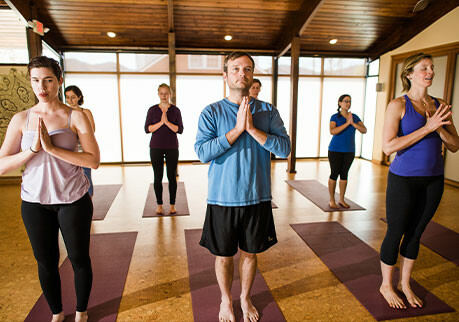
"I bow to the divine in you" or "I honor the divine in you just as I honor and see the divine in myself." It is a salutation in a few cultures, in India and yoga communities, a "hello" and "goodbye" and it is accompanied by bringing together the hands at the heart centre or third eye.
 
I have found myself crying and sad since doing yoga. What is this about? 
Yoga brings up a lot inside of us. It starts to release "layers" of physical tissue (muscle and connective) that could be the way we're holding ourselves since an injury or trauma. When we begin to release the tissue, the underlying pain begins to release as well. 
 
What should I do with that "release"?
It will pass and move out of your physical body as you stay constant with the practice.
 
Why is my practice hard somedays and and not others? 
Some days can be challenging due to the weather, sleep, diet and of course, attitude. Make sure you are getting plenty of sleep and that your diet is as clean as you want your practice to be. You are and feel what you eat. As you’re purifying your body and mind, it is important to keep it purified for greater results. 
 
How many yoga classes can I do a day and can I do too much yoga? 
You can take all the yoga you want. It will not hurt you. Balancing your practice out with gentle class and then a more challenging class is a nice blend if you're doing 2 in one day.
 
How will yoga change my lifestyle?
Yoga will not change your lifestyle, only you can change your lifestyle if you choose to. Over the medium to long term, a regular yoga practice (3 - 5 times a week) will help you manage stress, build inner confidence, strengthen your body and deepen your spiritual awareness.


Before Class

 
When I show up there’s always someone different checking in classes. Who are these various folks? 
"Karma Yogi's check in classes as trade for yoga at BMY. They are well trained and should be able to answer yoga center questions for you, but please lean on your teacher for Yoga related questions. 
 
Are the clothes that I'm wearing appropriate?  
If you are comfortable and able to move freely, yes. If you are attending sweaty (HOT) classes, wearing lycra is helpful but not necessary.
 
I've noticed the classes are large. How do I make sure I have mat space? 
Especially in the New Year (January-March) and during events like a 30 Day Yoga Challenge, classes are pretty full. Please arrive 10 minutes early if you can. Sign in. Take your shoes off and go straight to creating your mat space in the yoga room. You can change (but please no shoes in the yoga room) and use the restroom after you’ve laid down your mat. 
 
Why do we have to be on time?
Black Mountain Yoga classes generally start with quiet time during which students reflect on their intention. Walking into class after it has started is extremely distracting and disrespectful to other students. Moreover, if you arrive late, you may miss the warm up postures which are critical to deeper postures.


During Class

Why can't we leave when we want to?
Black Mountain Yoga classes are systematically planned to leave you feeling rested and energized. Leaving in the middle of a class before completing the full sequence could leave you agitated, make you more susceptible to injuries from not cooling down properly, and is disruptive and disrespectful to the rest of the class.

Why is it important to rest during savasana?
To allow our bodies absorb the benefits of the asana practice.

Physically resting in savasana allows the heart rate to return to normal, promotes a soothing of the nervous system, allows the oxygenated blood, we have been working so hard to produce, circulate completely around the body.

Mentally it gives us a further opportunity to still our minds and emotionally savasana allows us to feel and be at peace with whatever has come up as a result of the practice.

What should I be doing with my breath? 
The breath is key to the space and depth of your yoga practice. Try to limit the amount of thought going into the breath or the pose and focus purely on the Inhalation and Exhalation. Steady is the breath, steady is the mind and the body becomes as well.

Why do we breath through the nose during asana practice?
To keep the body and mind calm. Breathing through the mouth is said to prompts the body's "fight or flight" mechanism, elevating the heart rate, blood pressure and blood acidity levels.

Why should we do the postures at our own pace?
You are the only one who knows your body's limits and abilities. The teachers will encourage you to explore those limits, but students must take responsibility for their own practice and bodies. If you are new to exercise, you will need to learn the difference between stretching muscles and pain. The former is something to work though, the latter is something you should avoid.

Why do the teachers make adjustments to our postures?
To help you achieve the correct alignment and to help you avoid possible injury if the posture is performed incorrectly.

Why is important to go only as far as your body feels comfortable, and no further?
To avoid injury, you should only go as far as you feel able to. Although the teachers will encourage you to go further, you are the only person who knows what it feels like to be in your body. So in a way you are your own best teacher.

What does Om mean?
In The Heart of Yoga, T.K.V. Desikachar says "the ancient syllable "Om" is the shortest of the Mantras and in Indian tradition it is a word suggestive of God."

He further elaborates that "the scriptures tell us "Om" is the planets primordial vibration from which the entire universe has arisen. All other sounds are contained within it.

It is believed "Om" is the mother of all languages. Repetition of "Om" enables us to maintain mental and emotional calmness, overcome obstacles and enable understanding.

An analysis of "Om" as it is written in Sanskrit shows that it is made up of A, U, M and a symbol representing resonance. So "Om" has four aspects.

The first is A, a sound that comes from the belly, is formed in the open throat, and is voiced with the mouth open. As with many alphabets, A is the first letter of the Sanskrit alphabet. The second aspect is the U, a sound that is formed in the middle of the mouth. The mouth is not as wide as it is for sounding the A. With the third sound, M the mouth closes. The sound rises to the nasal passages, from where the resonance, the forth aspect of "Om" issues forth.

Saying "Om" is actually a form of meditation.

What does Namaste mean?
"I bow to the divine in you" or "I honor the divine in you just as I honor and see the divine in myself." It is a salutation in a few cultures, in India and yoga communities, a "hello" and "goodbye" and it is accompanied by bringing together the hands at the heart centre or third eye.


Health

Can yoga help insomnia?
Yes it can. Yoga helps to balances the body's melatonin levels, the chemical which regulates your body clock. Physical exertion and mental concentration of yoga helps to relax your body and reduce stress.

Is it normal to have pimples after starting yoga?
This is an individual reaction, but more common to Hot yoga. Practicing yoga in a heated room can open some people's pores. When going out to the cooler temperature, the pores close up quickly and any dirt on the face may cause an infection. Alternatively, deep pimples and strong skin reactions can result from toxins being cleared from deep within the body.

Is it normal to have a headache after your first class?
Not if you have drunk lots of water. Getting a headache after your first (or any later) class could be the sign of a toxin flush and dehydration.

Why do some people feel dizzy during or after class?
There are many possible reasons for this. The main ones are: not breathing enough; not drinking enough water; ate too much before class or haven't eaten for a long time and have low blood sugar.

Can I practice yoga during my menstruation?
Yes you can, but this is very an individual choice. Many teachers recommend avoiding practice during the first two days of your period. Many also suggest avoiding inversions like shoulder-stand, headstand and handstand during your period. Others suggest more restorative practices and asana during your period.

I just found out I am pregnant, should I do yoga?
Yoga is a great way to support you body and the newly forming body of your child. There are some precautions however, so you will want to let your doctor and your teachers know that you are pregnant. (especially if you are in your first trimester).

Why should pregnant women not take hot yoga?
Pregnant women generally should avoid elevating their heart rate above 130 or raising their body's core temperature excessively – two things which are very difficult to maintain during Hot yoga.

Will I lose weight by practicing yoga?
Many people find their weight finds a healthier level through the practice of yoga. For some people this means they lose weight, for others they gain weight. Remember that weight is not a good way to judge health and fitness. Especially as yoga helps strengthen muscles and muscle weighs more than fat.


Food & Drink

Why shouldn't we eat before class?
Some people may feel nauseous if they have eaten a meal 2 – 3 hours before coming to class. Other people can eat half an hour before practicing and feel fine. When to eat is a very individual thing. As you are trying to work it out, err on the side of caution.

If you stomach has food in it during practice, the postures might cause the food to push-up against your cardiac valve at the top of the stomach. In the long term, this might damage your cardiac valve.

What should my diet be like? 
Whole grains, veggies and fruit. Less sugar, less heavy food. Fish and chicken are great proteins to have in your diet if you eat meat. Beef and pork can cause calcium deficiency and create an underlying number of issues emotionally and physically due to the body having to work extra hard to digest. 4oz of meat is a good amount per meal. 
 
What about coffee and alcohol? 
These two things (along with narcotics and smoking) cause the body and mind to be less present and create more toxicity in the body and spirit. Reducing the use of all of these will help your yoga tremendously. Coffee before a practice can give you the "jitters" and you will find yourself falling out of poses and not being able to stay balanced or present.  

Why is it important to drink lots of water before and after class?
Drinking water is the single most important thing you can do for your health – even if you are not practicing yoga. And if you are practicing yoga (or doing other exercise) it's even more important. Our bodies are 80% water and most of us are dehydrated already. Every cell of our body contains and relies on water to function properly.

If you are practicing Hot, Power, Ashtanga or other strong yoga practices, it is even more important to be fully hydrated before class and re-hydrate after class.

Why shouldn't we drink water during practice?
During your practice, you are working on the posture, breathing or honing your mental focus. Drinking water breaks your focus and concentration and can be distracting to the students around you. However if you are not fully hydrated before class, then you should certain take sips of water at appropriate times during the practice.

When can I eat after class?
Wait about 20 minutes to let you body return to normal, and then eat as you normally do.

Do I have to be vegetarian to practice yoga?
You don't have to do anything special or different to practice yoga. All you have to do is start practicing. Through regular practice you may feel like changing your diet, but if not – no problem!


Copyright ©2012 Black Mountain Yoga . 120 Broadway Street . Black Mountain . NC 28711 . 828.669.2939 . contact us: click here